

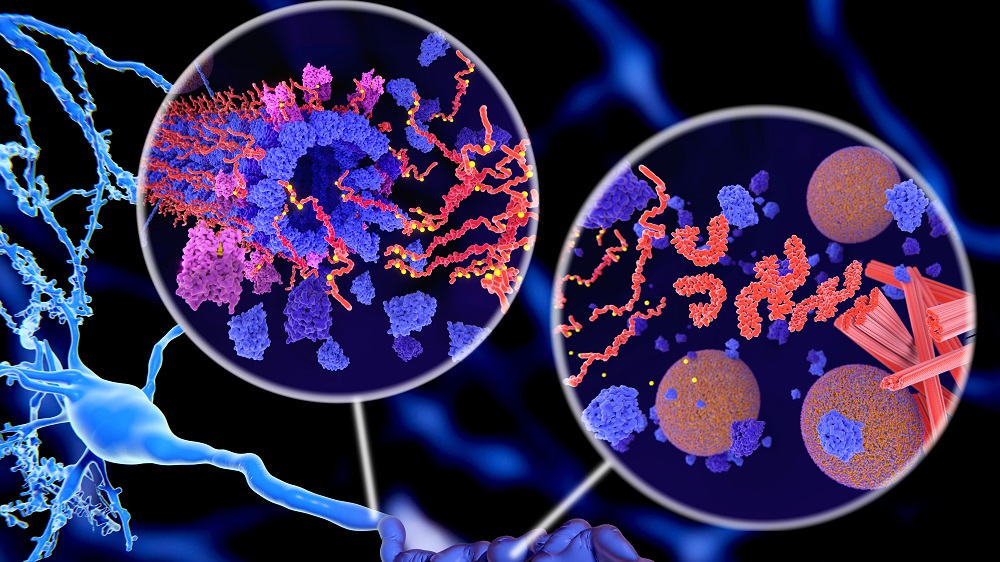
Recent studies published in Cell Reports Medicine detail a significant advancement in the use of mRNA technology for targeting tau aggregation in Alzheimer’s disease. Researchers have developed a novel nanoparticle that efficiently penetrates the blood-brain barrier, utilizing natural neurotransmitter pathways to deliver TRIM11 mRNA, a ligand known for its ability to dissolve tau aggregates.
Tau and Amyloids
Alzheimer’s disease is characterized by the deposition of amyloid beta between neurons and the aggregation of tau within neurons. While both are critical to the pathology of Alzheimer’s, emerging evidence suggests that tau aggregation may play a more significant role in disease progression than previously thought [1]. While some therapeutic approaches focus on disaggregating tau tangles post-formation [2], there has yet to be an FDA-approved solution specifically targeting tau aggregates.
In particular, this work highlights the action of TRIM11, a ligase that does not rely on ATP for its function. TRIM11 is known to be overexpressed in brain cancers [3], but its downregulation in neurons is prevalent in Alzheimer’s disease [4]. Addressing the challenge of delivering therapeutics across the blood-brain barrier (BBB), the researchers utilized lipid nanoparticles (LNPs) designed to carry mRNA-based treatments effectively [5].
Sneaking the mRNA In
The researchers engineered an LNP known as PLNP that mimics the structure of acetylcholine, thus gaining entry into target cells through established neurotransmitter pathways. When neuron and microglial cell lines were treated with PLNP, the uptake of mRNA was markedly improved in comparison to unformulated “naked” mRNA, which showed negligible cellular uptake. The mRNA delivered by PLNP successfully reached the cytosol, avoiding degradation by lysosomes. A subsequent experiment demonstrated that inhibiting choline significantly limited mRNA uptake, confirming the hypothesis that the PLNP utilized the intended pathway for cellular entry.
In vivo studies were conducted on wild-type Black 6 mice, revealing that PLNP delivered nearly 17 times more mRNA than standard LNPs. The presence of mRNA was confirmed across various brain regions using fluorescent reporters.
In a pivotal experiment involving TRIM11 fused with a fluorescent reporter, PLNP exhibited superior efficiency compared to conventional LNPs when tested in vitro. The outcome of administering TRIM11 alongside okadaic acid—a compound that induces tau pathology—showed a significant reduction in tau tangles. Importantly, the TRIM11 produced in cells localized with the remaining tau aggregates, indicating its direct impact on tau pathology.
Effective Against Alzheimer’s in a Mouse Model
The effectiveness of PLNP was further evaluated in male mice genetically predisposed to Alzheimer’s disease. At approximately 7.5 months old—an age at which these mice begin to develop tau tangles—mice were administered PLNP injections three times over two weeks, after which their behavior and brain changes were assessed.
The results were promising; mice treated with PLNP exhibited no statistically significant differences compared to wild-type mice. Measures of behavior indicated a strong preference for new objects and superior performance on the Morris water maze test. Additionally, their open-field behavior and nesting tendencies closely matched those of wild-type mice, with effects persisting for three months post-treatment. Notably, markers characteristic of tau pathology were nearly eradicated in the PLNP-treated group. Inflammatory markers such as IL-6 and TNF-α, which typically indicate neuroinflammation in this strain, were also significantly reduced following treatment.
| Parameter | PLNP-Treated Mice | Wild-Type Mice | Tau-Prone Mice |
|---|---|---|---|
| Preference for Novel Objects | Strong | Strong | Weak |
| Morris Water Maze Performance | Significantly Better | Normal | Poor |
| Inflammatory Biomarkers (IL-6, TNF-α) | Reduced | Baseline | Elevated |
“Together, these results demonstrate that systemically administered PLNP-mTRIM11 effectively reduces insoluble Tau aggregates and suppresses neuroinflammatory responses in the Alzheimer’s disease brain,” summarized the research team. These findings suggest a highly promising therapeutic strategy for modifying the disease’s trajectory.
Despite the encouraging results, the research has notable limitations. The primary experiments were conducted exclusively on male mice genetically engineered for Alzheimer’s, and there remains a concern about possible off-target effects due to the functional nature of tau protein. The research group aims to expand their investigations to include older animals, involve diverse models, and utilize additional biomarkers to authenticate their results.
In the spirit of progress, we kindly ask for support. As a non-profit foundation, we maintain a commitment to free access to news and educational content, relying on contributions from individuals like you. Every donation, regardless of the amount, supports independent journalism and helps sustain our mission.
Literature
- [1] Brier, M. R., et al. (2016). Science Translational Medicine, 8(338), 338ra66-338ra66.
- [2] Seidler, P. M., et al. (2022). Nature Communications, 13(1), 5451.
- [3] Di, K., Linskey, M. E., & Bota, D. A. (2013). Oncogene, 32(42), 5038-5047.
- [4] Perez-Nievas, B. G. (2023). Nature Neuroscience, 26(9), 1481-1481.
- [5] Wang, C., et al. (2025). Nature Materials, 24(10), 1653-1663.
About the Author
Josh Conway
Josh has been writing and editing Lifespan articles for over a decade and is responsible for the continuous production of daily news content. With a background in programming, he is a long-time advocate for anti-aging medicine.
Stay Informed
Sign up for our newsletter to keep updated on the latest news and developments from the Lifespan Research Institute!
© 2025 Lifespan Research Institute – ALL RIGHTS RESERVED









Discussion