

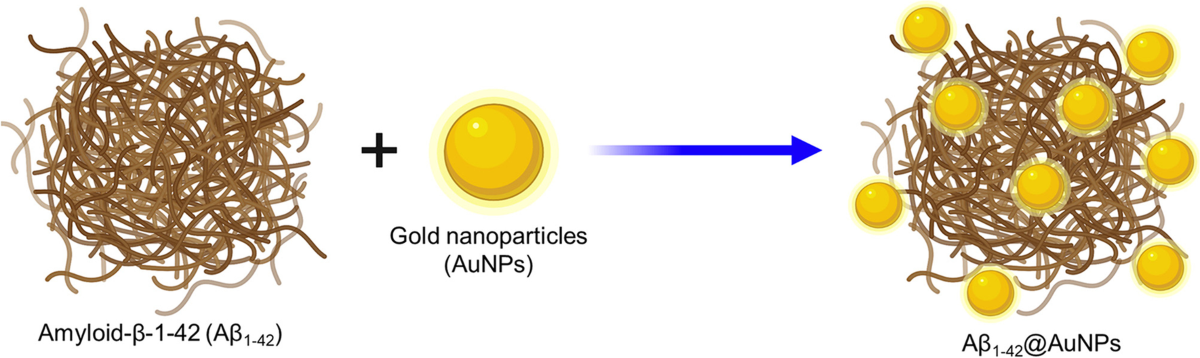
Alzheimer's disease (AD) is a progressive neurodegenerative disorder characterized by memory loss and cognitive decline. One of the hallmarks of this condition is the accumulation of **amyloid-beta (Aβ)** peptide, which forms plaques in the brain. Recent advancements have highlighted the potential role of gold nanoclusters (AuNCs) as a therapeutic strategy, providing novel insights into mechanisms aimed at combating AD.
Understanding the Mechanism of Action
Gold nanoclusters (AuNCs) are small, nanoscale aggregates of gold that have shown promising properties in medicine. Research indicates that AuNCs can inhibit the fibrillation of Aβ, effectively preventing the formation of neurotoxic aggregates. A pivotal study has shown that smaller AuNCs are particularly effective in suppressing Aβ aggregation when compared to their larger counterparts, which may actually accelerate fibrillation.
Research Insights
Recent studies on AuNCs have revealed several important findings:
- Amyloid-Beta Fibrillation Inhibition: AuNCs significantly prolong the lag phase of Aβ fibrillation, leading to decreased levels of oligomers and a corresponding reduction in plaque formation (Gao et al., 2017).
- Neuroprotective Properties: Evidence suggests that AuNCs possess anti-inflammatory and antioxidant effects, which may contribute to the protection of neurons undergoing damage in Alzheimer’s disease (Zhao et al., 2021).
- Therapeutic Delivery: The capabilities of nanotechnology to enhance drug delivery across the blood-brain barrier are crucial for improving therapeutic efficacy in Alzheimer's treatment (UCL News, 2025).
Methodology
The effectiveness of AuNCs was evaluated using a combination of in vitro and in vivo methodologies. The studies included:
- Control groups treated with Aβ alone versus groups receiving AuNC treatment.
- Fluorescence microscopy for accurate quantification of fibrillation rates.
- Animal models to assess cognitive function improvements following treatment.
Limitations and Future Directions
While preliminary outcomes are promising, challenges remain, particularly in the areas of:
- Toxicity: Long-term effects and potential bioaccumulation of gold nanoclusters in biological systems require thorough investigation.
- Clinical Translation: There is a necessity for more comprehensive clinical trials to validate the efficacy and safety of AuNCs in human subjects.
Future research directives should focus on optimizing the size and functionalization of AuNCs to bolster their therapeutic potential, alongside a more in-depth exploration of their mechanisms.
Conclusion
Gold nanoclusters signify a novel strategy in combating Alzheimer’s disease. By effectively inhibiting amyloid-beta fibrillation and displaying neuroprotective properties, AuNCs may play a critical role in future therapies.
Tables
Table 1: Comparison of AuNP Sizes and Their Effects on Aβ Fibrillation
| NP Size | Effect on Aβ Fibrillation |
|---|---|
| Small AuNCs | Inhibits fibrillation |
| Large AuNPs | Accelerates fibrillation |
Table 2: Potential Applications of Gold Nanoclusters in Alzheimer's Treatment
| Application | Description |
|---|---|
| Fibrillation Inhibition | Prevents plaque formation |
| Neuroprotection | Reduces oxidative stress |
| Drug Delivery | Enhances therapeutic efficacy |
References
* Gao, G., Zhang, M., Gong, D., Chen, R., Hu, X., & Sun, T. (2017). Nanoscale, 9(12), 4107-4113.
* Zhao, J., Xu, N., Yang, X., Ling, G., & Zhang, P. (2021). Applied Mathematics and Computation, 333, 213-224.
* UCL News, (2025). [Nanoparticles reverse Alzheimer’s pathology in mice](https://www.ucl.ac.uk/news/2025/oct/nanoparticles-reverse-alzheimers-pathology-mice).
* PMCID: 12473956. [Advances in Gold Nanoparticles for the Diagnosis and Management of Alzheimer’s Disease](https://pmc.ncbi.nlm.nih.gov/articles/PMC12473956).
Additional Academic Sources
- The size-effect of gold nanoparticles and nanoclusters in the inhibition of amyloid-β fibrillation - A significant pathological signature of Alzheimer's disease is the deposition of amyloid-β (Aβ) plaques and the associated synaptic dysfunction.
- The roles of gold nanoparticles in the detection of amyloid-β peptide for Alzheimer's disease - Gold nanoparticles can inhibit Aβ aggregation and improve the efficiency of sensors.





Discussion