

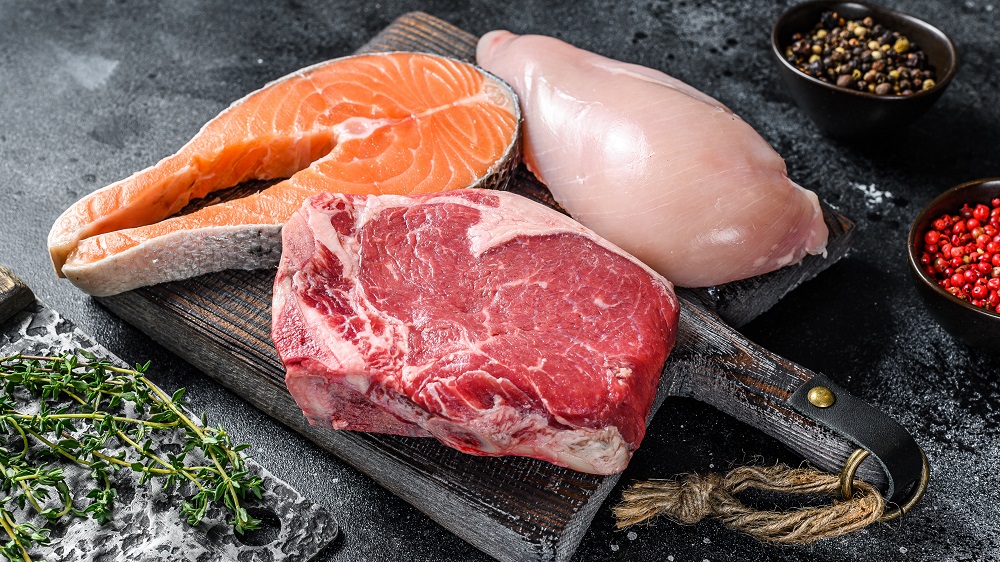
Meat Consumption May Benefit APOE4 Carriers
Eating fish confers similar benefits for this group.
March 20, 2026
Carriers of the APOE ε4 allele, which is linked to Alzheimer’s disease, were much less likely to develop Alzheimer’s if they consumed more unprocessed meat or fish. This result is likely to be linked to the diets available in different regions throughout human history, suggesting evolutionary divergence.
A new study has established this counterintuitive connection, which might have roots in human evolution [1].
The Meat Connection
The APOE gene, which produces apolipoprotein E, a protein central to lipid transport in the brain and body, comes in three variants (alleles): ε2, ε3, and ε4. APOE genotypes are a major risk factor for Alzheimer's disease, with:
- ε3: the most common and “neutral” genotype.
- ε2: the rarest and protective allele.
- ε4: significantly increases the risk of Alzheimer's, especially in homozygous individuals (ε4/ε4).
Interestingly, ε4 is the ancestral human allele, having emerged approximately 1-6 million years ago; ε3 appeared around 200,000 years ago, while ε2 emerged even later. Several hypotheses explain this evolution, particularly related to changes in human diet. One prominent theory suggests that early humans underwent a “hypercarnivorous” phase, followed by a gradual return to a more plant-based diet [2]. The emergence of ε4 may coincide with this meat-heavy dietary period, while ε3 appeared as diets diversified.
This theory is substantiated by evidence that the modern distribution of ε4 is most prevalent in populations with historically meat-based diets [3]. Additionally, certain populations maintaining traditional subsistence lifestyles do not exhibit the same cognitive penalties associated with ε4 seen in Western cultures, and may even experience cognitive benefits attributed to this allele [4].
Less Cognitive Decline and Dementia for ε4 Meat Eaters
In a new study conducted by the Karolinska Institutet in Sweden, researchers analyzed data from over 2,100 participants from the Swedish National Study on Aging and Care, correlating dementia and cognitive decline with APOE genotype and meat consumption patterns. Notably, Northern Europe exhibits a higher frequency of the ε4 allele, contrasting with Southern Europe where ε4 is less prevalent. This pattern corresponds well with historical dietary reliance on animal-based foods in Northern Europe compared to grain-based agriculture in Southern regions.
Participants were followed for up to 15 years, during which their dietary habits were assessed using a food-frequency questionnaire at baseline and during subsequent follow-ups. The cohort was predominantly Northern European with a mean age of 71 years. Participants were divided into two subgroups based on their APOE allele presence: ε4 carriers and non-carriers. Approximately 80% of the non-ε4 group consisted of individuals with the ε3/ε3 genotype, while around 90% of the ε4 group consisted of individuals with the ε3/ε4 genotype.
The primary analysis adjusted for numerous factors including age, sex, education, occupation, and lifestyle habits. The outcome measures included:
- Cognitive trajectory: the rate of change in global cognition score over 10 years.
- Dementia diagnosis.
The findings revealed that higher total meat consumption correlated with significantly improved cognitive trajectories among ε4 carriers, a result not seen in non-carriers. Quintile-based analyses showed that those in the highest meat consumption group (Q5) performed similarly to non-carriers, indicating that the typical cognitive decline associated with the ε4 genotype was mitigated at high meat intake.
The beneficial effect was most pronounced in episodic memory, which is particularly susceptible to decline in Alzheimer’s. In contrast, memory types such as semantic memory and verbal fluency exhibited directionally consistent yet statistically insignificant results.
Meat Consumption and Dementia Risk
The ratio of red meat to poultry was not significantly related to cognitive outcomes, indicating the health benefits were attributed solely to overall unprocessed meat consumption. Conversely, a higher ratio of processed to total meat was negatively associated with cognitive trajectory in ε4 carriers, suggesting processed meats could have adverse effects regardless of genotype.
| Consumption Category | Findings | Associated Risks |
|---|---|---|
| Total Meat Consumption | Better cognitive trajectory in ε4 carriers | Lower dementia risk by 55% |
| Unprocessed Meat | 15% lower all-cause mortality in ε4 carriers | Beneficial if replacing fish |
| Processed Meat | Neutral or harmful effects | Unfavorable for dementia irrespective of genotype |
Reinforcement from Two Large Cohorts
The study's authors corroborated their findings with two substantial previously published studies. In the UK Biobank, unprocessed red meat consumption was inversely linked to dementia, primarily driven by ε4 carriers [5]. The Nurses’ Health Study and Health Professionals Follow-up Study also indicated favorable cognitive trends for ε4 carriers consuming unprocessed red meat, contrasting with adverse trends for non-carriers [6].
“Those who ate more meat overall had significantly slower cognitive decline and a lower risk of dementia, but only if they had the APOE 3/4 or 4/4 gene variants,” said Jakob Norgren, the first author and researcher at the Department of Neurobiology, Care Sciences and Society at the Karolinska Institutet. “There is a lack of dietary research into brain health, and our findings suggest that conventional dietary advice may be unfavorable to a genetically defined subgroup of the population. As the prevalence of APOE4 is approximately twice as high in Nordic countries as in Mediterranean countries, we are particularly positioned to pursue tailored dietary recommendations for this risk group.”
Literature
[1] Norgren J, Carballo-Casla A, Grande G, et al. (2026). Meat Consumption and Cognitive Health by APOE Genotype. JAMA Netw Open, 9(3):e266489.
[2] Ben‐Dor, M., Sirtoli, R., & Barkai, R. (2021). American journal of physical anthropology, 175, 27-56.
[3] Singh, P. P., Singh, M., & Mastana, S. S. (2006). 33(3), 279-308.
[4] Trumble, B. C., Stieglitz, J., Blackwell, A. D., et al. (2016). The FASEB journal, 31(4), 1508.
[5] Zhang, H., Greenwood, D. C., Risch, H. A., et al. (2021). The American journal of clinical nutrition, 114(1), 175-184.
[6] Li, Y., et al. (2025). Neurology, 104(3), e210286.
About the Author
Arkadi Mazin
Arkadi is a seasoned journalist and op-ed author with a passion for learning and exploration. His interests span from politics to science and philosophy. Having studied economics and international relations, he particularly focuses on the social aspects of longevity and life extension. He firmly believes that extending life is a noble pursuit that deserves a higher priority in our civilization's agenda—a cause he is committed to advancing.
We would kindly ask for your support. We are a non-profit foundation, and unlike some other organizations, we maintain no shareholders and no products to sell. All our news and educational content is freely accessible, relying on patrons like you. Each contribution, regardless of size, helps sustain independent journalism.









Discussion